Planning on driving to a holiday destination in your vehicle during the summer?
Then you better make sure that the brakes on your vehicle are working correctly.
Go to a local independent garage and get them to check your brake pads, discs and also your brake fluid levels so as to ensure maximum peace of mind before you set off on your travels. Brake failure can be catastrophic!
Brakes are pretty much the most important safety device on your car. If you've even partially lost your brakes in the past, you'll remember the change of underwear that followed. Inspecting your brakes twice a year for wear and damage can protect you and your passengers whilst saving you money by catching any damage before it becomes too costly.
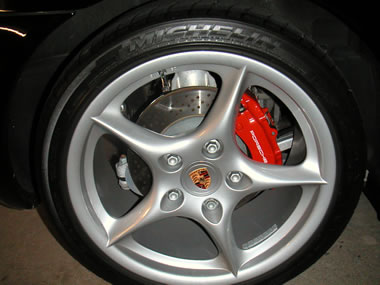
On many cars you can inspect your brakes without removing the wheel. If your car has alloy wheels with spaces in the middle, you can get a proper assessment done by just peeping through the hole. Whether you can peep through your wheel or you have to take the wheel off, be sure you have a clear view of the brake pads and the big shiny disc.
Let's inspect the disc first. It should be shiny from the inside to the outer edge, and fairly uniform. Don't worry if you can see slight lines in it, this is normal wear. However, if there are any rough spots or pronounced grooves in the disc, you should replace your brake discs. Brake discs should always be replaced in pairs so that your car's driveability and safety are not compromised.
Now take a look at the pads. You'll have to peek up to see them, but if you follow the surface of the disc to the top, you'll see the outside pad touching the disc. If there is 1/8" or less remaining on the pad, it's time for new ones. That's about the height of two pennies stacked. Don't worry, brake pads are pretty inexpensive. Finally, take a look at your brake lines. Rubber coated lines should be soft and supple, not cracked and rigid. If you see cracks in flexible brake lines they will need to be replaced straight away. Also be sure to inspect the hard, metal lines. These can become corroded, especially in snowy regions where chemicals are used on the roads. Your brakes will always be looked at during your annual service and during your MOT - always take note of advisories! If in any doubt get your brakes checked out by your local independent service and repair centre! Happy Motoring!
Brakes are pretty much the most important safety device on your car. If you've even partially lost your brakes in the past, you'll remember the change of underwear that followed. Inspecting your brakes twice a year for wear and damage can protect you and your passengers whilst saving you money by catching any damage before it becomes too costly.
On many cars you can inspect your brakes without removing the wheel. If your car has alloy wheels with spaces in the middle, you can get a proper assessment done by just peeping through the hole. Whether you can peep through your wheel or you have to take the wheel off, be sure you have a clear view of the brake pads and the big shiny disc.
Let's inspect the disc first. It should be shiny from the inside to the outer edge, and fairly uniform. Don't worry if you can see slight lines in it, this is normal wear. However, if there are any rough spots or pronounced grooves in the disc, you should replace your brake discs. Brake discs should always be replaced in pairs so that your car's driveability and safety are not compromised.
Now take a look at the pads. You'll have to peek up to see them, but if you follow the surface of the disc to the top, you'll see the outside pad touching the disc. If there is 1/8" or less remaining on the pad, it's time for new ones. That's about the height of two pennies stacked. Don't worry, brake pads are pretty inexpensive. Finally, take a look at your brake lines. Rubber coated lines should be soft and supple, not cracked and rigid. If you see cracks in flexible brake lines they will need to be replaced straight away. Also be sure to inspect the hard, metal lines. These can become corroded, especially in snowy regions where chemicals are used on the roads. Your brakes will always be looked at during your annual service and during your MOT - always take note of advisories! If in any doubt get your brakes checked out by your local independent service and repair centre! Happy Motoring!